
Yet again, my mind and heart don't match- I intellectually "get" veganism but don't need to become vegan to sleep at night.
I haven't written anything on here in a while. The usual self-criticism and analysis-paralysis can always get in the way of just writing, but with my blog, simply logging in forces me to confront the hard reality - instead of just worrying that I'm shallow and pedantic, there's actual written evidence that I'm shallow and pedantic.

As usual, I'm getting my butt in gear because of a girl. A colleague, compatriot, and companion requested that I lay out my conflicted attitudes towards veganism, and speciesism - so I know at least one person will read this, so here goes.
Vegan is a relatively recently coined term for those who, in addition to being vegetarian, forgo the use of all animal products. So, in contrast to pescetarians who still eat fish, or vegetarians who still eat milk and eggs, vegans forgo all of that. No products resulting from animal suffering. Their reasons are many, and really hard to argue against - both pragmatically and ethically.
The pragmatic objection: we get animal products through means ranging from the unsustainable to the downright nefarious. The methane from cow farts, burps, and manure is contributing to global warming more than vehicle emissions. Most of food mega-industry puts profits before provision and is unconcerned with how food processing depletes food's nutritional value.
The ethical objection: it should be a dealbreaker that we get animal products through animal suffering. Chickens are crammed into cages where they cannot move. Cows are abused and mothers and offspring are separated so the industry machine can roll on. (Google it if you want to feel terrible.) Even a humanely killed cow or chicken is still being killed so that we can eat it- when it doesn't need to die at all.
That is the crux of a more involved problem with "speciesism". Speciesism is a label for the belief that the rights, well-being, and non-suffering of human beings is more important than that of non-human beings. Animal liberationists call into question whether "speciesism" is really a fair justification for what we do to animals. We seek to prevent suffering for humans, but why not non-humans? Who decided that animals matter less?
If animals are capable of feeling pain in the same way that we are - does this suffering mean less just because they're a different species?
To get theological, does Baby Jesus cry more tears over a suffering human than a suffering cow, or doesn't every part of God's creation matter to God? (Well, plenty of believers talk about humans having "dominion" over the earth and God giving us animals to eat - but I'd fire back that in the Garden of Eden, people were vegetarians, and the Old Testament God only permitted people to eat meat later as a concession. Christian vegetarians would agree.) Or, taking God out of it, if all consciousness is way for the cosmos to know itself, why are humans better than chickens?
Crucial to the argument is the fact that people don't "need" to kill animals for food anymore. Early in human evolution, around the time we were bashing each other's skulls in to survive, we also had to bash in other animals' skulls to survive. But, just as we developed society to avoid bashing each other's skulls in, so have we developed agriculture and food infrastructure that means we no longer have to do things that way. We've also developed ways to make food that is delicious without using animal products.
So there, intellectually, is an argument for veganism and no longer using animal products. I watched the documentary Speciesism and had lengthy conversations with my vegan companion, and I see the point to all of it.
So why am I not vegan?
It's more than just not wanting to give up hamburgers. It's more than just the force of habit, and being so accustomed to being a carnivore in a society where the majority of food is meat-based.
Deep down in my gut, giving up animal products is not the change I need to make to sleep at night. (How do I sleep at night, anyway? I'd like to think giving it my all with the stuff I'm passionate about, treating people how I'd want to be treating, seeking a meaningful life...but it ain't working.)
I think part of my reticence to embrace speciesism was driven home by some Facebook conversations today. Sometimes vegans draw comparisons between the suffering of animals being ignored under our noses, and the suffering of people in concentration camps being ignored under German society's noses. (Godwin's Law of Nazi Analogies aside...)
I observed two polar opposite reactions to that statement, basically:
a) How can you compare what happens to chickens and cows to the awful hell that millions of humans went through in the concentration camps?
b) Well, why not compare them? Who decided that human beings were more important than animals? If suffering is bad, why wouldn't we want to prevent suffering on the scale of hundreds of millions of animals?
If I had to "pick" a) or b), I'd have to admit I still have a hard time equating the suffering of non-human beings to the suffering of human beings. "Guilty of speciesism!" I can't really argue with that accusation.
But I can't really "argue" emotionally with either perspective - I can just unpack the premises as if I'm describing an electrical wiring schematic. Am I going to argue with the person who is offended that the suffering of cows is compared to the murder of six million Jews? No, because I understand their premises. Am I going to argue with the person who says, well, why don't we look at all suffering equally, and why is our species so special? No, because I understand their premises.
Long ago, trying to "pick a side" would have thrown me into some kind of obsessive compulsive tailspin, but I've become a lot less emotionally attached to most arguments. Even topics where I have an unshakeable opinion: i.e. the judicial system being unfair to black Americans or the need for marriage equality and LGBTQ rights - I can usually listen to any perspective without getting too hot-headed. Especially because my opinion - apart from the ballot box or maybe, slim chance, a conversation or debate - isn't really going to change much.
John Lennon was a wife-beater, but that doesn't stop me from posting his song "How Do You Sleep".
Part of me sleeping at night is finding some kind of recognition that there's a limit to what I can do. There's a lot of awfulness in the world, but there is comparatively little we can do about it. All we can do is try to find what we need to do to sleep at night. Call that growing up?
Nick
 |
| Now she can help me sleep at night...by bringing a vegetable midnight snack! |
I haven't written anything on here in a while. The usual self-criticism and analysis-paralysis can always get in the way of just writing, but with my blog, simply logging in forces me to confront the hard reality - instead of just worrying that I'm shallow and pedantic, there's actual written evidence that I'm shallow and pedantic.

As usual, I'm getting my butt in gear because of a girl. A colleague, compatriot, and companion requested that I lay out my conflicted attitudes towards veganism, and speciesism - so I know at least one person will read this, so here goes.
Vegan is a relatively recently coined term for those who, in addition to being vegetarian, forgo the use of all animal products. So, in contrast to pescetarians who still eat fish, or vegetarians who still eat milk and eggs, vegans forgo all of that. No products resulting from animal suffering. Their reasons are many, and really hard to argue against - both pragmatically and ethically.
 |
| This adorable moment is just before the calf was pulled away from its mother to be used for veal. |
The pragmatic objection: we get animal products through means ranging from the unsustainable to the downright nefarious. The methane from cow farts, burps, and manure is contributing to global warming more than vehicle emissions. Most of food mega-industry puts profits before provision and is unconcerned with how food processing depletes food's nutritional value.
The ethical objection: it should be a dealbreaker that we get animal products through animal suffering. Chickens are crammed into cages where they cannot move. Cows are abused and mothers and offspring are separated so the industry machine can roll on. (Google it if you want to feel terrible.) Even a humanely killed cow or chicken is still being killed so that we can eat it- when it doesn't need to die at all.
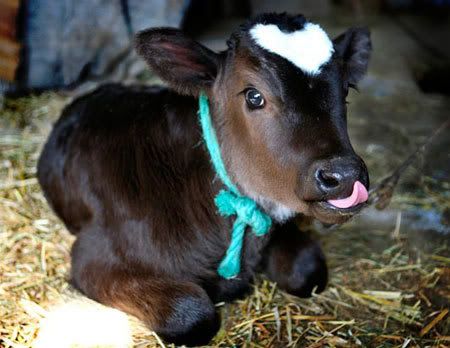 |
| I put this cuddly calf here to emotionally manipulate you into not enjoying your next hamburger. |
That is the crux of a more involved problem with "speciesism". Speciesism is a label for the belief that the rights, well-being, and non-suffering of human beings is more important than that of non-human beings. Animal liberationists call into question whether "speciesism" is really a fair justification for what we do to animals. We seek to prevent suffering for humans, but why not non-humans? Who decided that animals matter less?
If animals are capable of feeling pain in the same way that we are - does this suffering mean less just because they're a different species?
To get theological, does Baby Jesus cry more tears over a suffering human than a suffering cow, or doesn't every part of God's creation matter to God? (Well, plenty of believers talk about humans having "dominion" over the earth and God giving us animals to eat - but I'd fire back that in the Garden of Eden, people were vegetarians, and the Old Testament God only permitted people to eat meat later as a concession. Christian vegetarians would agree.) Or, taking God out of it, if all consciousness is way for the cosmos to know itself, why are humans better than chickens?
Crucial to the argument is the fact that people don't "need" to kill animals for food anymore. Early in human evolution, around the time we were bashing each other's skulls in to survive, we also had to bash in other animals' skulls to survive. But, just as we developed society to avoid bashing each other's skulls in, so have we developed agriculture and food infrastructure that means we no longer have to do things that way. We've also developed ways to make food that is delicious without using animal products.
 |
| Or we have food that's "accidentally" vegan because the artificial flavors include no dairy or eggs. |
So there, intellectually, is an argument for veganism and no longer using animal products. I watched the documentary Speciesism and had lengthy conversations with my vegan companion, and I see the point to all of it.
So why am I not vegan?
 |
| Reason 1: Burger Madness at Arthur's. |
It's more than just not wanting to give up hamburgers. It's more than just the force of habit, and being so accustomed to being a carnivore in a society where the majority of food is meat-based.
Deep down in my gut, giving up animal products is not the change I need to make to sleep at night. (How do I sleep at night, anyway? I'd like to think giving it my all with the stuff I'm passionate about, treating people how I'd want to be treating, seeking a meaningful life...but it ain't working.)
I think part of my reticence to embrace speciesism was driven home by some Facebook conversations today. Sometimes vegans draw comparisons between the suffering of animals being ignored under our noses, and the suffering of people in concentration camps being ignored under German society's noses. (Godwin's Law of Nazi Analogies aside...)
 |
| Hitler Cat. Puns about the "Fuhrer" as Purr-rer or Fur-rer are a given. |
a) How can you compare what happens to chickens and cows to the awful hell that millions of humans went through in the concentration camps?
b) Well, why not compare them? Who decided that human beings were more important than animals? If suffering is bad, why wouldn't we want to prevent suffering on the scale of hundreds of millions of animals?
If I had to "pick" a) or b), I'd have to admit I still have a hard time equating the suffering of non-human beings to the suffering of human beings. "Guilty of speciesism!" I can't really argue with that accusation.
But I can't really "argue" emotionally with either perspective - I can just unpack the premises as if I'm describing an electrical wiring schematic. Am I going to argue with the person who is offended that the suffering of cows is compared to the murder of six million Jews? No, because I understand their premises. Am I going to argue with the person who says, well, why don't we look at all suffering equally, and why is our species so special? No, because I understand their premises.
Long ago, trying to "pick a side" would have thrown me into some kind of obsessive compulsive tailspin, but I've become a lot less emotionally attached to most arguments. Even topics where I have an unshakeable opinion: i.e. the judicial system being unfair to black Americans or the need for marriage equality and LGBTQ rights - I can usually listen to any perspective without getting too hot-headed. Especially because my opinion - apart from the ballot box or maybe, slim chance, a conversation or debate - isn't really going to change much.
John Lennon was a wife-beater, but that doesn't stop me from posting his song "How Do You Sleep".
Part of me sleeping at night is finding some kind of recognition that there's a limit to what I can do. There's a lot of awfulness in the world, but there is comparatively little we can do about it. All we can do is try to find what we need to do to sleep at night. Call that growing up?
Nick


